


 Eligibility for Australian citizenship by conferral can come up in quite a lot of methods.
The most typical is to fulfill the ‘common eligibility standards’ and have efficiently accomplished a citizenship check. Briefly, that is the widespread pathway for migrants who’ve lived in Australia on visas and in the end obtained everlasting residency. As soon as they’ve been current in Australia for the required interval, they might meet necessities for citizenship by conferral underneath the overall eligibility standards.
Nonetheless, if a person isn’t eligible underneath the overall standards, citizenship by conferral additionally caters for some extra distinctive circumstances:
- Individuals who have been born to a former Australian citizen;
- Individuals born in ‘the Territory of Papua’ earlier than 16 September 1975;
- Stateless individuals.
The article under describes the primary of those.
The Australian Citizenship Act (1948)
For some context, citizenship was beforehand administered by the Australian Citizenship Act (1948) (1948 Act).
Ultimately, the 1948 Act not mirrored fashionable Australia:
- It was vastly tied to British nationality ideas;
- It had strict provisions associated to the automated lack of Australian citizenship in sure circumstances (it will grow to be related under);
- It didn’t mirror multicultural Australia.
Consequently, the 1948 Act was repealed and changed by the present Citizenship Act which commenced on 1 July 2007 (2007 Act).
The present Act additionally notably up to date the legal guidelines on citizenship by conferral and citizenship by descent.
Individuals born outdoors Australia to a former Australian citizen
Extra generally, if an individual is born outdoors to a present Australian dad or mum, they’d rationally be eligible for Australian citizenship by descent. The overarching requirement is that the kid had an Australian dad or mum at time of beginning.
Nonetheless, there should still exist a small cohort of people that, at time of beginning, didn’t have an Australian dad or mum as a result of that dad or mum misplaced their citizenship prior. Consequently citizenship by descent wouldn’t be doable.
Regardless of this, subsection 21(6) of the present 2007 Act makes citizenship by conferral doable for an individual born outdoors Australia whose dad or mum was an Australian however ceased to be an Australian on account of part 17 of the previous 1948 Act.
The weather of subsection 21(6) of the 2007 Act are as follows:
1. Native land
The applicant will need to have been born outdoors Australia, as outlined by part 3. Part 3 offers that Australia, when utilized in a geographical sense, contains exterior territories (Norfolk Island, Christmas Island or the Cocos (Keeling) Islands).
3. Standing of dad or mum at time of applicant’s beginning
That is crucial half. Paragraph 21(6)(b) and (c) requires that:
- the related dad or mum of the applicant should not have been an Australian on the time of the applicant’s beginning, and
- that, previous to the applicant’s beginning, the dad or mum ceased to be an Australian citizen underneath part 17 of the 1948 Act.
It’s value noting that the dad or mum, who ceased to be an Australian underneath part 17 of the 1948 Act, isn’t required to have re-acquired Australian citizenship to ensure that the applicant to fulfill subsection 21(6) of the 2007 Act.
What was part 17 of the 1948 Act?
Part 17 was in essence the automated lack of Australian citizenship if an individual outdoors Australia of “full age” and “full capability” acquired the citizenship of one other nation:
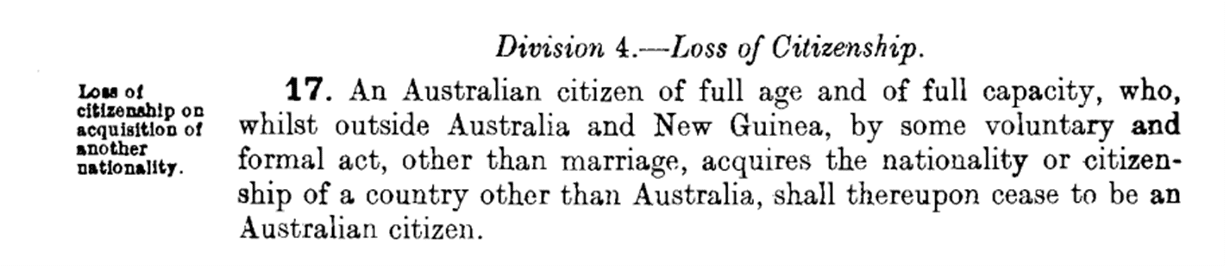
To make clear part 17 additional:
- From 26 January 1949 to 30 November 1973, an individual was thought of to be of full age in the event that they have been aged 21 or over;
- From 1 December 1973, an individual was of full age in the event that they have been aged 18 or over;
- An individual of full capability capable of make knowledgeable selections and understands the implications of their actions.
Part 17 is requires that the particular person needed to have undertaken a voluntary and formal act to amass the citizenship of one other nation. This may normally imply that they themselves made an software to grow to be a citizen, or utilized to re-acquire a citizenship that they’d beforehand misplaced. In different phrases, the acquisition of their non-Australian citizenship needed to be a deliberate and aware resolution.
Some eventualities from Division coverage that makes an attempt to make clear this embody:
- an Australian who acquires Irish citizenship as a result of their father was born there may be not essentially affected by part 17, as a result of they’re merely making use of for proof of a citizenship that they have been entitled to from beginning.
- However, if the particular person have been to register as an Irish citizen as a result of their grandfather was born there, then that particular person would have ceased to be an Australian citizen underneath part 17 as a result of they voluntarily utilized to grow to be a brand new Irish citizen.
Part 17 was repealed from the 1948 Act on 4 April 2002.
The sensible challenges
A serious problem with these issues can be that the Division of Dwelling Affairs (and its predecessors) wouldn’t have full data of people that misplaced their Australian citizenship underneath this provision. It’s because citizenship cessation underneath part 17 was “by operation of regulation” or computerized when a selected occasion happens, relatively than a course of that might be manually assessed and actioned.
Moreover, there was no requirement for an individual to report their acquisition of one other nation’s citizenship, and so the quantity of people that have been affected by part 17 could also be larger than what is thought. Consequently, in the case of their kids born abroad, confirming that the dad or mum misplaced their Australian citizenship, and extra particularly misplaced it on account of part 17 might be very troublesome to show and make sure with out household or historic data.
For these exploring the previous citizenship of their dad and mom, the Nationwide Archives of Australia could also be an fascinating place to start out.
How can Hannan Tew Legal professionals assist?
At Hannan Tew, our group of devoted legal professionals have vital expertise throughout advanced citizenship issues. In the event you require immigration help or have another migration-related queries, please get in contact with our skilled group by e-mail at [email protected] or by cellphone on +61 3 9016 0484.
It’s also possible to subscribe to our Australian immigration e-newsletter to remain updated with the newest immigration information.
