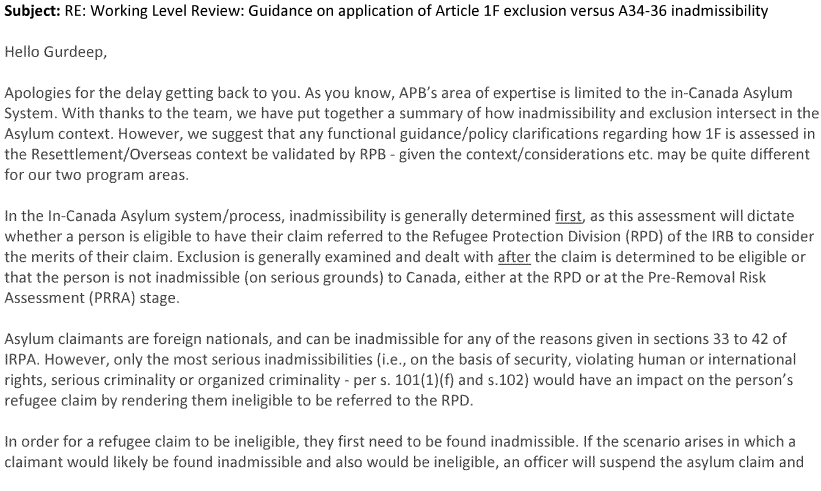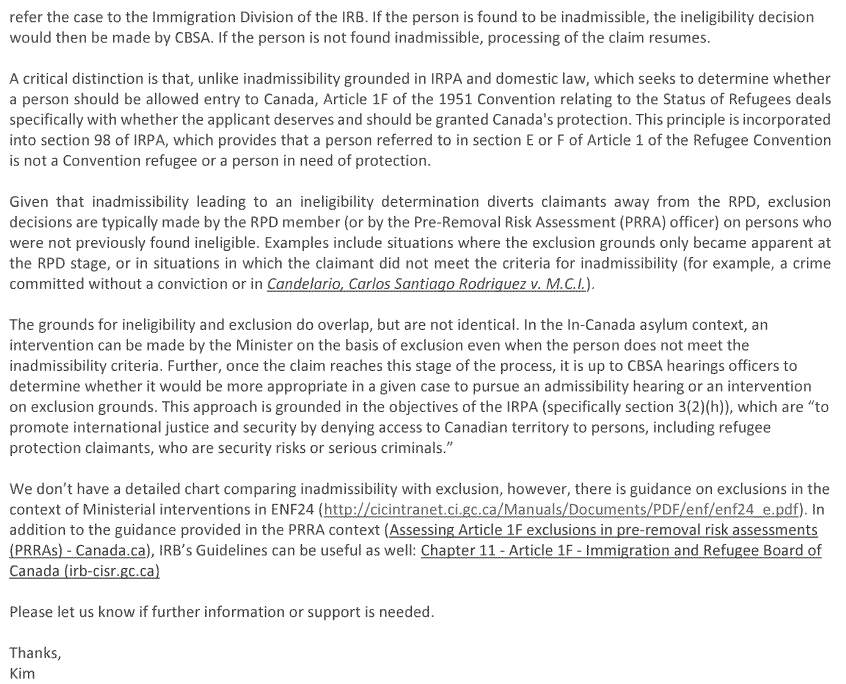


Article 1F(b) of the Conference Regarding the Standing of Refugees, Can. T.S. 1969 No. 6 (the “1951 Refugee Conference“) states that the provisions of this 1951 Refugee Conference shall not apply to any particular person with respect to whom there are critical causes for contemplating that they’ve dedicated a critical non-political crime exterior the nation of refuge previous to his admission to that nation as a refugee.
Part 98 of Canada’s Immigration and Refugee Safety Act (“IRPA” or the “Act“) incorporates Article 1F(b) of the 1951 Refugee Conference into Canadian immigration legislation.
What’s the Function of Article 1F(b)? Does Is it Restricted to Fugitives? If a Particular person is Rehabilitated Can They Nonetheless be Excluded from Refugee Safety?
In Febles v. Canada (Citizenship and Immigration Canada), 2014 SCC 68 (“Febles“), the Supreme Courtroom of Canada (the “Supreme Courtroom“) addressed the problem of whether or not the applying of Article 1F(b) of the 1951 Refugee Conference is just a matter of trying on the seriousness of against the law when it was dedicated, or whether or not it requires consideration of different issues, together with, for instance, whether or not a refugee claimant is a fugitive and/or whether or not a person is rehabilitated.
The Supreme Courtroom discovered that the aim of Article 1F(b) of the 1951 Refugee Conference is to exclude individuals who have beforehand dedicated a critical non-political crime from searching for refugee safety in Canada, interval. The Supreme Courtroom additional decided that Article 1F(b) just isn’t directed solely at fugitives. It’s also not restricted to a subset of significant criminals who’re undeserving (are harmful or not rehabilitated) on the time that they declare refugee safety. The Supreme Courtroom said:
Excluding individuals who have dedicated critical crimes could help a variety of subsidiary rationales — it might stop folks fleeing from justice; it might stop harmful and notably undeserving folks from coming into the host nation. Nevertheless, Article 1F (b) can’t be confined to any of those subsidiary functions. Excluding individuals who have dedicated crimes in different nations previous to searching for refugee safety could serve different state pursuits. It might assist protect the integrity and legitimacy of the refugee safety system, and, therefore, the required public help for its viability. It might deter states from exporting criminals by pardoning them or imposing disproportionately lenient sentences whereas supporting their departure elsewhere as refugees. Lastly, it might enable states to scale back the hazard to their society from all critical criminality circumstances taken collectively, given the tough activity and potential for error when making an attempt to find out whether or not criminals from overseas (on whom they’ve extra restricted sources of data than on home criminals) are not harmful. No matter rationales for Article 1F (b) could or could not exist, its function is evident in excluding individuals from safety who beforehand dedicated critical crimes overseas.
Therefore, it doesn’t matter whether or not a major time frame has handed since a person dedicated a critical offence.
The particular person is completely barred from claiming refugee standing in Canada.
What’s the Threshold for a “Severe” Crime?
In Febles, the Supreme Courtroom agreed with earlier Federal Courtroom selections {that a} “critical” crime for the aim of Article 1F(b) exclusion is one the place a most sentence of ten years or extra might have been imposed had the crime been dedicated in Canada.
Nevertheless, the Supreme Courtroom additionally cautioned that this customary “shouldn’t be perceive as a inflexible presumption that’s unattainable to rebut.” The court docket said: [citations removed for ease of reading]
The place a provision of the Canadian Prison Code has a big sentencing vary, the higher finish being ten years or extra and the decrease finish being fairly low, a claimant whose crime would fall on the much less critical finish of the vary in Canada shouldn’t be presumptively excluded. Article 1F(b) is designed to exclude solely these whose crimes are critical. The UNHCR has recommended {that a} presumption of significant crime could be raised by proof of fee of any of the next offences: murder, rape, youngster molesting, wounding, arson, medicine trafficking, and armed theft. These are good examples of crimes which might be sufficiently critical to presumptively warrant exclusion from refugee safety. Nevertheless, as indicated, the presumption could also be rebutted in a selected case. Whereas consideration of whether or not a most sentence of ten years or extra might have been imposed had the crime been dedicated in Canada is a helpful guideline, and crimes attracting a most sentence of ten years or extra in Canada will usually be sufficiently critical to warrant exclusion, the ten-year rule shouldn’t be utilized in a mechanistic, decontextualized, or unjust method.
Given the variety of hybrid offences within the Prison Code, the precept in Canadian immigration legislation that any crime is “critical” if the utmost penalty is ten years or extra has usually resulted in seemingly absurd penalties. As famous above, nevertheless, within the Article 1F(b) context, Canadian courts have resisted the mechanical software of this method to figuring out whether or not an offence is critical.
In Jayasekara v. Canada (Minister of Citizenship and Immigration), 2008 FCA 404 (“Jayasekary“), for instance, the Federal Courtroom of Enchantment famous that for the aim of Article 1Fb evaluation, a hybrid offence ought to not be routinely deemed to be indictable. The Federal Courtroom of Enchantment said:
I ought to add for the sake of readability that Canada, like Nice Britain and america, has a good variety of hybrid offences, that’s to say offences which, relying on the mitigating or aggravating circumstances surrounding their fee, may be prosecuted both summarily or extra severely as an indictable offence. In nations the place such a alternative is feasible, the selection of the mode of prosecution is related to the evaluation of the seriousness of against the law if there’s a substantial distinction between the penalty prescribed for a abstract conviction offence and that supplied for an indictable offence.
Canada v. Ammar is am instance of the Jayasekary precept. The difficulty earlier than the Courtroom was whether or not the Refugee Safety Division erred in figuring out that the committing of Prison Sexual Conduct within the Fourth Diploma didn’t preclude a person from claiming refugee standing pursuant to Article 1Fb. The Division of Justice primarily argued that the offence needs to be deemed to be indictable. In the end, primarily based on Jayasekara, the Federal Courtroom rejected this argument.
Therefore, when the sentence falls in direction of the low finish of a broad sentencing vary, a refugee claimant shouldn’t be presumptively excluded, thereby leaving the onus with the Minister to influence the Board that the crime was critical.
Lastly, because the Federal Courtroom dominated in Mohamed v. Canada (Citizenship and Immigration), the Supreme Courtroom feedback in Febles apply to all crimes allegedly dedicated overseas, “whether or not involving convictions or flights from justice.”
What’s an Instance of Contemplating what a Canadian Courtroom’s Sentence Might Be?
In Mohamed v. Canada (Citizenship and Immigration), the Federal Courtroom took the considerably distinctive method of citing a British Columbia Courtroom of Enchantment (the “BCCA“) sentence for a person convicted inside Canada of supporting the Liberation Tigers of Tamil Eelam. The BCCA wrote:
The sentencing decide acknowledged the second issue, the persevering with hazard the offender presents, raises explicit difficulties in terrorist offences. By definition, these offences are sometimes motivated by political, spiritual, or ideological functions or targets. Such beliefs are sometimes immutable. Thus, Mr. Thambaithurai’s lack of regret was maybe not shocking, given his Tamil heritage, the impression of the struggle on his household, and his persevering with concern for the dire circumstances of the Tamil inhabitants in Sri Lanka. The sentencing decide, nevertheless, concluded Mr. Thambaithurai didn’t current an ongoing terrorist menace, given his in any other case good character. Furthermore, by the point Mr. Thambaithurai got here earlier than the courts, concern about additional terrorist financing of the LTTE had been abated by occasions in Sri Lanka. In Might 2009, Prabhakaran was killed and the Sri Lankan authorities declared victory over the LTTE.
[…]
Nor am I persuaded that the sentence of six months’ incarceration was unfit. Whereas terrorist offences have distinctive options, they’re ruled by the identical sentencing framework and targets as different crimes below the Prison Code, and Parliament has left the complete vary of sentencing choices, besides conditional sentences, open to the courts for consideration in coping with them. The sentencing decide precisely outlined the details and Mr. Thambaithurai’s private circumstances. He thought-about the sentencing targets within the Prison Code, and reviewed the related mitigating and aggravating elements. He acknowledged the distinctive and critical nature of terrorism however, in my opinion, correctly accepted the Crown’s submission that Mr. Thambaithurai’s actions fell on the low finish of the size.Regardless of that, the sentencing decide determined a suspended sentence wouldn’t adequately serve the targets of deterrence and denunciation. As an alternative, he ordered a custodial sentence of six months, a consequence that will ordinarily be seen as a harsh penalty for a primary offender with an in any other case unblemished document. As effectively, Mr. Thambaithurai’s conviction could have long-lasting results, as it would intervene together with his capability to journey past Canada.
[Emphasis added]
What About Financial Crimes? Does Article 1F(b) apply to them?
Pursuant to the Federal Courtroom of Enchantment choice in Xie v. Canada (Minister of Citizenship and Immigration), [2005] 1 FCR 304, 2004 FCA 250, financial crimes can lead to exclusion from refugee safety.
Does Article 1F(b) Apply to Dismissed Costs?
Article 1F(b) will also be utilized the place fees are dismissed.
In Zrig v Canada (Minister of Citizenship and Immigration), 2003 FCA 178, the Federal Courtroom of Enchantment said that:
it’s doable to exclude each the perpetrators of significant non-political crimes searching for to make use of the Conference to elude native justice and the perpetrators of significant non-political crimes {that a} States feels shouldn’t be allowed to enter its territory, whether or not or not they’re fleeing native justice, whether or not or not they’ve been prosecuted for his or her crimes, whether or not or not they’ve been convicted of these crimes and whether or not or not they’ve served the sentences imposed on them in respect of these crimes.
In Pineda v Canada (Minister of Citizenship and Immigration), 2010 FC 454, the Federal Courtroom defined why it is sensible {that a} dismissal can result in exclusion. The Courtroom said:
This makes good sense on condition that fees may be dismissed for quite a lot of causes together with procedural points, rejection of essential proof for technical causes, or just because the accused raised an affordable doubt. The Conference doesn’t undertake the stringent customary relevant in legal proceedings and the RPD could certainly be happy that proof produced by the Minister, which will not be admissible in a court docket of legislation, is ample to lift a critical chance that the applicant has certainly dedicated a critical crime.
Counting on Findings of Overseas Courts
In Ching v. Canada (Citizenship and Immigration), 2015 FC 860, an Article 1FA case involving a excessive profile Chinese language refugee claimant who is needed in China for alleged corruption, the Federal Courtroom clarified when it’s appropriated for the Immigration and Refugee Board to depend on overseas circumstances. The Courtroom said:
I might not go as far as to counsel that there can by no means be reliance on findings of overseas courts. Nevertheless, to be able to depend on overseas findings one would anticipate that the overseas court docket’s causes rise to the extent of significant causes for contemplating {that a} crime has been dedicated. Right here, the RPD at paragraphs 47 and 48 acknowledges the constraints and the duty it could be performing. The paragraphs learn:
[47] Minister’s counsel concedes that the authorized system within the PRC has defects that lead to human rights violations. The panel notes that that is supported by nation paperwork in addition to the proof of the Minister’s knowledgeable witness on the IAD listening to Professor Vincent Yang, and by the claimant’s witness Mr. Clive Ansley on the ID listening to.
[48] I don’t conclude from this, nevertheless, that each particular person charged with a legal offence within the PRC has been subjected to human rights violations or that the authorized system is registering false convictions for political causes in each case. The problem for this panel is to look at the proof earlier than it and decide if this claimant is the sufferer of such abuses or is definitely a legal fleeing prosecution in his house nation. This requires a contextual examination of the proof earlier than me.
Mere statements by a overseas court docket will fall brief in response to the RPD, but that’s precisely what was completed on this case: there can’t have been a contextual examination of the proof earlier than the Panel as a result of there was no proof apart from findings of overseas courts. As an alternative, the Panel appeared for affirmation of findings in proof that’s, at greatest, peripheral.
Does Article 1F(b) Apply to Confessions obtained by Torture?
In Sing v. Canada (Minister of Citizenship and Immigration), 2005 FCA 125 (“Sing“), the Federal Courtroom of Enchantment was requested to reply the next query:
The place the Minister depends upon interrogation statements produced overseas by overseas authorities businesses, should the Minister set up these statements had been voluntary when made, notably the place there may be some proof of an absence of voluntariness of a number of of the statements, and proof of torture generally utilized in acquiring statements from individuals detained is included in info on normal nation circumstances?
The Federal Courtroom of Enchantment answered:
The Minister has the onus to supply credible or reliable proof on which the Board can decide whether or not a claimant needs to be excluded from the Conference refugee definition. The Board just isn’t certain by any authorized or technical guidelines of proof and, in any proceedings earlier than it, it might obtain and base a choice on proof adduced within the proceedings that it considers credible or reliable within the circumstances of the case. Statements obtained by torture or different merciless, inhumane or degrading remedy or punishment are neither credible or reliable.
As effectively, and as famous in Gurbuz v. Canada (Citizenship and Immigration), in figuring out whether or not Article 1F(b) ought to apply, the Refugee Safety Division has jurisdiction to contemplate allegations of corruption or ethnic persecution within the overseas authorized system and to contemplate whether or not a overseas conviction is real.
Does the Authorities Need to Present Discover of What Crime an Article 1F(b) Allegation Will probably be Based mostly On?
In Sing the Federal Courtroom of Enchantment was additionally requested to reply the next licensed query:
Is the Minister required to provide discover prematurely of a listening to, of particular legal acts alleged in opposition to the claimant, or is it ample if proof on the subsequent listening to reveals specifics of legal acts allegedly dedicated by the claimant?
The Federal Courtroom of Enchantment answered:
No. The Minister just isn’t required to supply discover of the particular legal acts alleged in opposition to a claimant… the Minister is required to specify the elements of Article 1F which might be related to the declare and to set out briefly the legislation and details on which he depends. The Minister just isn’t obliged to supply particulars at the usual that could be required, for instance, in a legal indictment…
The Minister is required to adduce credible or reliable proof on the listening to that’s related to the questions raised by the exclusionary floor, which is whether or not there are critical causes for contemplating whether or not a claimant has dedicated a critical non-political crime exterior Canada previous to arrival on this nation.
Underneath the brand new Act, the Minister is now required to provide discover prematurely of a listening to in accordance with part 25 of the brand new Guidelines. He should additionally adjust to part 29 of the brand new Guidelines, which usually require {that a} claimant be supplied with the paperwork to be relied on by the Minister not later than 20 days earlier than the listening to.
Rehabilitation
In Hernandez Fables v. Canada (Citizenship and Immigration), 2011 FC 1103, the Federal Courtroom licensed the next query:
When making use of article 1F (b) of the United Nations Conference referring to the Standing of Refugees, is it related for the Refugee Safety Division of the Immigration and Refugee Board to contemplate the truth that the refugee claimant has been rehabilitated because the fee of the crime at situation?
In different phrases, ought to a refugee claimant who has dedicated a critical non-political crime overseas, however has since been rehabilitated, be precluded from claiming refugee standing?
The Federal Courtroom of Enchantment has definitively answered that it doesn’t matter whether or not an individual who has dedicated a critical non-political crime overseas has been rehabilitated. The seriousness of against the law is to be assessed as of the time of its fee; its seriousness doesn’t change over time, relying on whether or not the claimant is subsequently rehabilitated and ceases to pose a hazard to the general public.
In rejecting the argument {that a} purposive method to Article 1F regarded an evaluation of whether or not a person was presently a hazard to the general public, the Federal Courtroom of Enchantment cited the European Courtroom of Justice, which wrote in 2010 that:
… the grounds for exclusion at situation had been launched with the purpose of excluding from refugee standing individuals who’re deemed to be undeserving of the safety which that standing entails and of stopping that standing from enabling those that have dedicated sure critical crimes to flee legal legal responsibility. Accordingly, it could not be in step with that twin goal to make exclusion from refugee standing conditional upon the existence of a gift hazard to the host Member State.
Rehabilitated people who’re excluded from refugee safety nonetheless have the choice of acquiring a keep of elimination by acquiring a constructive Pre-Elimination Threat Evaluation.
Inner IRCC Correspondence