


Residents in Canada are seeing decrease rents.
The Canada Mortgage and Housing Company (CMHC), the nation’s nationwide housing authority, has reported declines in asking rents in a number of main housing markets as a consequence of outflows of worldwide college students and international employees.
Softening markets embrace Toronto, Vancouver, and Calgary.
Get our FREE Newcomer’s Information to Canada, with high ideas for saving on lease
This text will cowl key findings from CMHC’s 2025 Mid-12 months Rental Market Replace impacting new renters to Canada, and ideas for newcomers to avoid wasting on lease.
Adjustments in rents
Marketed rents in Calgary, Toronto, Vancouver, and Halifax noticed declines of between 2-8% in Q1 of 2025, in comparison with the identical time in 2024.
Over the identical interval, different key housing markets, corresponding to Montreal, Edmonton, and Ottawa noticed the speed of enhance in marketed rents gradual considerably in comparison with the identical interval in 2024.
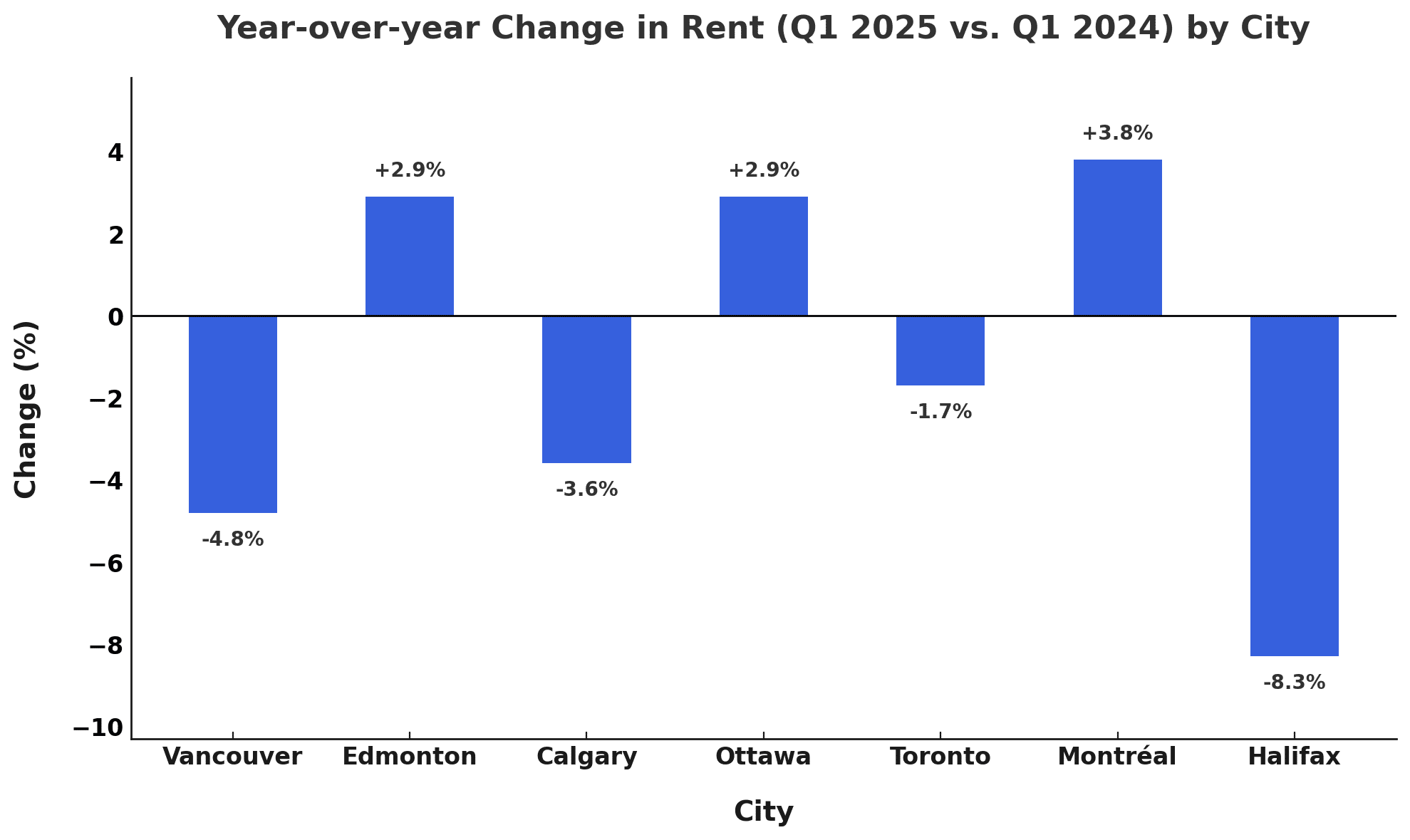
| Metropolis | 12 months-over-year change (Q1 2024 vs. Q1 2023) | 12 months-over-year change (Q1 2025 vs. Q1 2024) |
|---|---|---|
| Vancouver | 1.20% | -4.80% |
| Edmonton | 10.00% | 2.90% |
| Calgary | 10.70% | -3.60% |
| Ottawa | 3.80% | 2.90% |
| Toronto | -0.50% | -1.70% |
| Montréal | 2.40% | 3.80% |
| Halifax | 11.70% | -8.30% |
The CMHC attributes these decreases to reductions on the demand aspect of the rental market, at the side of robust beneficial properties in provide.
Marketed or asking rents are a very related metric to many newcomers getting into Canada’s rental housing market, as these are typically the costs that these new to the nation should deal with, within the absence of robust social ties in a brand new nation.
Landlords are observing that vacant models are taking longer to lease–particularly for brand spanking new purpose-built rental properties in Toronto, Vancouver, and Calgary—on account of elevated competitors from well-supplied secondary rental markets.
Homeowners within the secondary rental market are usually extra keen to decrease rents to cut back vacancies.
In the meantime, purpose-built rental operators are adjusting to market situations by providing incentives to draw new tenants, corresponding to one month of free lease, shifting allowances, and signing bonuses. Regardless of this, the CMHC stories that many operators count on they might must decrease rents over the subsequent few years.
The report additional particulars that completions of rental housing models are above their “10-year historic averages” in most of Canada’s housing markets, indicating a constructive development for the nation’s rental housing provide.
Immigration restrictions stymie inhabitants development
The latest decline in marketed rents can be linked to slower worldwide migration and a discount in momentary residents, which in flip has impacted the just lately all-time excessive rental demand in Canada.
After reaching a peak round mid-2023, marketed rents dropped extra noticeably in census metropolitan areas (CMAs) which might be extra delicate to those shifts, corresponding to Vancouver, Toronto, and Halifax.
Moreover, the CMHC stories that Canada’s cap on worldwide scholar consumption and adjustments to how college students are distributed throughout provinces are placing downward strain on rental demand in British Columbia, Ontario, and Nova Scotia.
In the meantime, development within the variety of non-permanent residents slowed in Quebec and Alberta, presumably contributing to a slowed development in marketed rental costs in these areas.
In Q1 2025, these provinces all skilled declines within the variety of work and research allow holders.
Between January 1, 2025, and April 1, 2025, Canada’s inhabitants grew by simply 20,107 individuals. This slowdown in inhabitants development was primarily as a consequence of a decline within the variety of momentary residents and everlasting resident admissions.
In accordance with Statistics Canada, the variety of momentary residents (work and research allow holders) in Canada fell by 61,111 from January 1, 2025, to April 1, 2025.
Optimistic outlooks
All through the rest of 2025, Canada’s rental market is projected to be formed by slower inhabitants development and evolving employment situations.
With demand lagging behind the addition of latest provide, the market is predicted to remain in a interval of adjustment. That is particularly evident in Ontario, the place lowered worldwide migration targets are having an influence, notably in areas near post-secondary establishments.
This era of adjustment is sorely wanted within the context of Canada’s present rental market.
Whereas the above tendencies are encouraging, general housing affordability has not eased a lot, as marketed rents to revenue ratios stay excessive throughout many housing markets.
Marketed rent-to-income ratios in March of every 12 months:
| Metropolis | 2022 | 2023 | 2024 | 2025 |
|---|---|---|---|---|
| Vancouver | 18.20% | 17.00% | 16.30% | 17.80% |
| Edmonton | 11.50% | 12.20% | 12.30% | 12.50% |
| Calgary | 11.60% | 12.40% | 14.10% | 13.70% |
| Toronto | 14.50% | 14.70% | 15.20% | 16.40% |
| Ottawa | 12.10% | 11.30% | 11.80% | 12.50% |
| Montréal | 11.50% | 12.20% | 13.20% | 13.30% |
| Halifax | 12.70% | 13.50% | 14.10% | 13.90% |
Hire management: A strong solution to save on lease for newcomers
Hire management refers to laws that restrict the quantity landlords can elevate lease over time.
These laws are designed to guard tenants from sudden, steep lease will increase that might make housing unaffordable, and may present extra inexpensive entries into Canada’s labour marketplace for newcomers.
In Canada, provincial governments are chargeable for creating and implementing lease management laws. This implies the foundations can range broadly relying on the place you reside:
| Province | Hire Managed? |
|---|---|
| Alberta | No |
| British Columbia | Sure |
| Manitoba | Sure |
| New Brunswick | No |
| Newfoundland and Labrador | No |
| Northwest Territories | No |
| Nova Scotia | Sure* |
| Nunavut | No |
| Ontario | Sure** |
| Prince Edward Island | Sure |
| Quebec | No |
| Saskatchewan | No |
| Yukon | No |
*Hire will increase are capped in Nova Scotia at 5% yearly till 31 December 2027.
**Hire management in Ontario is simply relevant to residential models constructed or first occupied previous to the fifteenth of November 2018. Newer constructing are exempt.
Discover rent-controlled properties, and save on bills by downloading our FREE Newcomer’s Information to Canada
